



For more than 75 years, Futamura has been developing and producing cellulose films, helping to lead innovation in cellulosic packaging solutions around the world. Our goal is simple: to create innovative, renewable packaging and product solutions that people can trust, that perform well and that help protect the planet for future generations. A big part of that commitment is reducing the environmental impact of our packaging and products at every stage of their lifecycle.
We know saying this is easy, but can we show that we practise what we preach? In this blog, we want to demonstrate one of the ways that we are measuring our environmental performance to hold ourselves accountable, and that is through carbon footprint assessment.
What is Carbon Footprint?
Carbon footprint has become a sustainability buzzword and was even named the UK winner of Oxford’s word of the year in 20071, reflecting that this term has permeated the public consciousness rather than being an industrial only discussion.
But where did it come from, and do we understand what it means?
The first use of the term itself is cited from a 1999 edition of a BBC Good Food Magazine2, 3, but many credit British Petroleum (BP) with popularising the term after a 2005 advertising campaign centred on carbon footprint awareness, albeit many speculate this was with some ulterior motives2, 3, 4, 5.
But whatever the motive behind naming this concept, what cannot be denied is the impact greenhouse gases on the environment.
The human influence on climate change was perhaps first recorded in 1938 by Guy Callendar6,7, who was described as an ‘amateur scientist’. The UKRI website stated that Callendar “decided to take a break from his day job and began painstakingly collecting records from 147 weather stations across the world. Doing all his calculations by hand, he discovered that global temperatures had risen 0.3°C over the previous 50 years.6” That doesn’t sound very amateur to me.
Although the link between climate change and the industrial revolution was made by Callendar, this was largely dismissed at the time but have since been shown to be remarkably accurate. In the years since, technology has advanced considerably allowing the impact of climate changed to be measured and tracked in detail, and I would thoroughly recommend checking out the UKRI6 and BBC7 website pages referenced in this document for more information on the history of climate change and climate monitoring.
So, this has led us to carbon footprint, or global warming potential (GWP), which measures the potential global warming impact of a process in CO2 equivalents of greenhouse gases between a defined start and end point. Different emissions can have a lesser or greater global warming impact so, for convenience, they are measured and then converted into ‘CO2 equivalents’ of greenhouse gases. For instance, one tonne of methane has the equivalent global warming impact of twenty-five tonnes of carbon dioxide.
But what does that mean in relation to Futamura UK’s cellulose films?
Cutting the Carbon Footprint of our Cellulose films
In the case of NatureFlex™, a complete Life Cycle Assessment (LCA) has been carried out from ‘Cradle to Gate’ focused on materials produced at our UK manufacturing facility. This means we measure and understand the impacts of all our raw materials (cradle), through the whole of our manufacturing process until the finished slit reel of film is ready to leave our site (gate). Futamura’s LCAs have all been carried out by Sphera (previously Thinkstep), or ERM, using the GaBi software. To learn more about this, please visit – Lifecycle Assessment – Futamura
We have recently reconducted this process to demonstrate the impact of site-wide collaborative initiatives, bringing together investment, technological innovation and operational discipline to deliver what we believed would be significant measurable benefits.
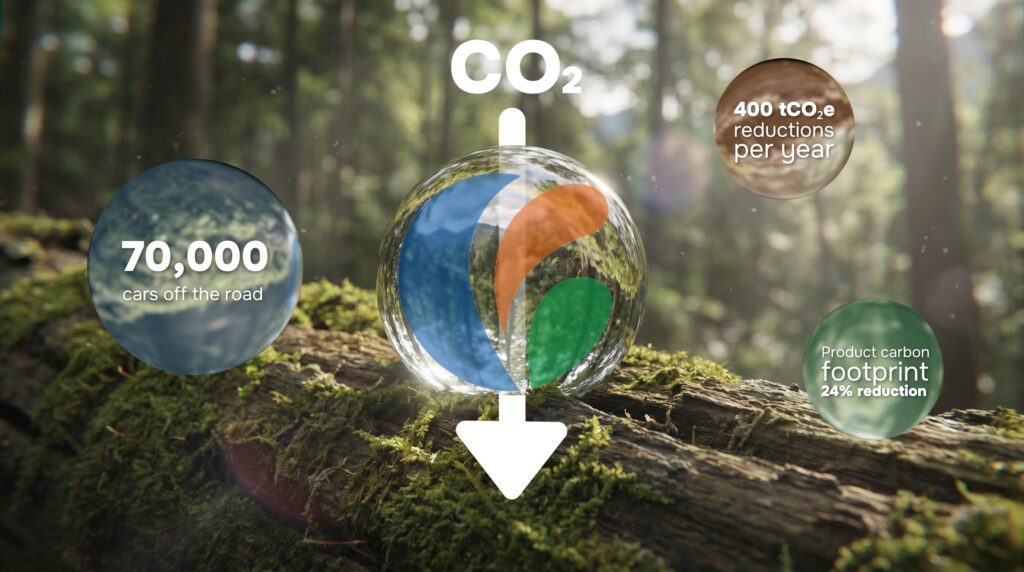
Strategic investment: The team introduced a high-performance compressed-air system and heat recovery technology, reducing steam demand and cutting carbon emissions by more than 400 tCO₂e each year.
Site-wide efficiency: Colleagues have reprogrammed air conditioning to run only when needed and upgraded 80% of the site to LED lighting, lowering energy use while maintaining or improving lighting quality.
Smarter working practices: Energy monitoring helped laboratory teams identify further savings, including using ovens only when required, shutting equipment down at weekends and improving day-to-day energy management.
And the results are in…
Since 2019, Futamura has delivered a cumulative carbon saving equivalent to removing ~70,000 cars from UK roads for an entire year. This figure represents avoided CO₂e emissions associated with lacquered (based on NatureFlex™ NVS) and plain film production between 2019 and 2025, calculated using IPCC AR6 GWP100 values from an independent third-party life cycle assessment from ERM*. This resulted in an average reduction of 24% of the carbon footprint of their NatureFlex™ films.
Mapping the next steps
We’re proud with the progress we have made, but we aren’t stopping there.
Building on this success, additional major investments are now underway and scheduled for implementation by 2027/28. One example is the recently announced, internally known, Wet Sulphuric Acid (WSA) project. The installation will divert waste gases from the production process to generate a valuable raw material via an oxidation process. Heat generated as a byproduct of the chemical reaction will then be used to generate steam, the main form of energy utilised in the production process.
Once operational, this asset will generate 15% of the total energy requirement of the Futamura UK site. These investments are projected to reduce Futamura’s CO₂e emissions even further, the equivalent to removing an additional ~4,000 cars from UK roads every year (based on 2025 production volumes). This represents another major step in reducing the carbon footprint of our products.
*The calculation is based on the difference in the carbon footprint between 2019 and 2025. Based on this, the actual amount of CO2e saved was ~100,000 tonnes.
References to cars removed from UK roads are illustrative equivalences based on average annual CO₂ emissions per UK car, using data from the UK Department for Transport. These figures do not represent actual cars taken off the road; they are provided solely to help contextualise the scale of avoided CO₂e emissions within our defined operational boundary.