


End of Life

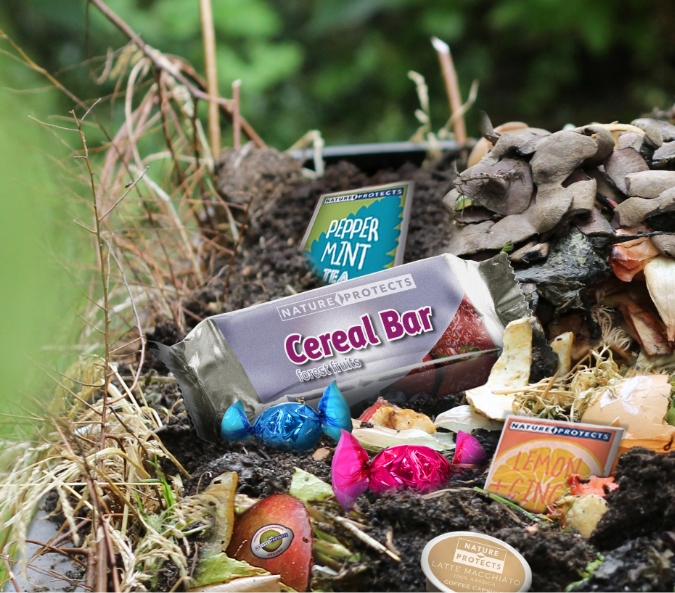
End of Life
Flexible packaging films are widely used due to their cost-effectiveness and excellent product protection qualities. By reducing product spoilage and damage, they significantly reduce waste across the packaged goods supply chain. However, their lightweight design, frequent use of mixed materials, potential for food contamination, and the presence of inks and adhesives, can render conventional mechanical recycling methods largely impractical. Combined with further challenges in collecting and sorting such materials, it means that incineration or landfill remain the most common and cost-effective end-of-life outcomes.

Designed with end-of-life in mind, NatureFlex™ can be composted at home, or collected by local authorities for industrial composting, where accepted, together with bio-waste collections. Compostable packaging can help to divert organic waste from landfill or incineration, when it is contaminated with food residues, and composting in turn returns valuable nutrients and carbon back to soils thereby improving soil health.
We are committed to expanding the end-of-life possibilities for our products. While NatureFlex™ is optimised for composting, we are actively exploring emerging advanced recycling technologies to support a multi-pathway approach to sustainable waste management.

For further information on each individual end-of-life option for NatureFlex™, click on the buttons below:


Industrial Composting
Industrial composting is a controlled process for transforming biodegradable waste into stable products used in agriculture. It involves two key phases:
- Active Phase: Micro-organisms break down the organic matter into carbon dioxide (CO2), water and humus, generating heat with temperatures typically between 50 and 60°
- Curing Phase: In this phase, decomposition slows, temperatures drop, and humus is formed.
Common technologies include windrow composting, aerated static piles, tunnel composting and in-vessel composting.
All NatureFlex™ grades are certified for industrial composting against standards such as EN13432, ASTM D6400, AS 4736 and ISO 17088. Composting plays a vital role in restoring soil health, supporting nutrient cycling, carbon sequestration, and food production.
Interested to know more about the EN13432 standard? Watch our video!
To demonstrate the compatibility of certified industrially compostable materials in industrial composting settings, Futamura, and other stakeholders, took part in a 2 year study as part of the Compostable Coalition UK, funded by the UKRI.
Watch the video below to find out more!
Ambient (Home or backyard) Composting
Home composting is a personal gardening practice, enabling households with gardens to turn kitchen and garden waste into compost for personal use. The practice can enrich soils in home gardens and reduce the amount of organic waste entering residual waste streams.
Several compostable films are suitable for home composting, including all NatureFlex™ grades, but certain other compostable films are only suited to industrial composting, due to a requirement for higher temperatures. NatureFlex™ films are certified for home composting according to the OK Compost Home protocol and/or are certified by Din Certco/ABA against the French (NF T51-800) or Australian (AS 5810) standards.
A common method used in home composting is the ‘slow-stack’ technique, whereby organic materials are gradually added to the composting bin or vessel and, over time, the material naturally decomposes to form nutrient-rich compost. Home composting should be approached with care, as, if not properly managed, methane can be released. Home composting can be seen as a complementary option within the broader organic waste management system, while industrial composting or anaerobic digestion remain the preferred methods for treating organic waste, due to their controlled conditions and scalability.
Watch our timelapse to see our metallised NatureFlex™ degrade under home composting conditions within 12 weeks!
Anaerobic Digestion
In an anaerobic digester, organic matter is degraded by micro-organisms in the absence of oxygen to produce biogas and compost. The biogas produced (carbon dioxide and methane) can be:
- Treated in a combined heat and power plant to produce electricity and steam, or
- Upgraded to biomethane, a renewable gas suitable for use as a fuel, or injection into the national grid.
As of 2025, there are 756 operational AD plants in the UK, with AD playing an important role in the generation of renewable energy. Anaerobic digestion (AD) is suitable for organic waste with high moisture content such as kitchen or food waste.
Although all NatureFlex™ grades are suitable for AD, many plants employ a de-packaging stage prior to the AD process, which means, in some cases, compostable packaging may not end up being processed through AD.
Please see the image below describing the different pathways by which certified compostable products can be processed through AD.
Incineration (EfW)

The incineration of municipal solid waste exploits the energy content of the material and reduces the amount of material to be landfilled. The technology is also called thermal recovery or incineration with energy reclamation.
There are two types of energy from waste (EfW) systems:
- Mass burn systems: The input is unsorted municipal solid waste with no pre-treatment.
- Refuse derived fuel systems: Municipal solid waste is sorted prior to input to ensure a defined quality of input material.
To address environmental concerns, The Waste Incineration Directive (2010/76/EC) was designed to prevent or limit negative effects on the environment due to incineration. Very high temperatures must now be achieved to ensure complete combustion and there are strict limits on plant incineration emissions to air. This continues to be enforced through Directive (EU) 2018/851 which amended The Waste Framework Directive (2008/98/EC).
Landfill
Landfills are designated burial sites for waste disposal. Modern sanitary landfills, also known as “dry tombs”, are engineered to be sealed off, preventing oxygen and moisture from entering, while controlling leachate (liquid runoff) and gaseous emissions.
A key environmental concern with landfills is the generation of landfill gas—primarily methane—produced during the slow biodegradation of organic materials. Some landfills, known as bioreactor landfills, are designed to accelerate this process and capture the methane for use as an energy source.
Under the Revised Waste Framework Directive (EU) 2018/851
Testing has shown that compostable films, including NatureFlex™, remain inert in a landfill environment and do not biodegrade due to the low moisture content present.
Mechanical Recycling
Mechanical recycling is a method by which waste materials are recycled into ‘new’ materials which have the same basic structure. The waste material is sorted, either manually or automatically, to separate the different materials. The different material streams are then cleaned and ground, prior to re-melting and being formed back into granules. The resulting recyclates can then be processed into new products.
Mechanical recycling is a well-established technology for conventional plastics, such as polyethylene and polyester, particularly for rigid bottles. There is much less film recycling, partly due to the light-weight nature of flexible materials, and so, unfortunately, they have less value. In addition, filmic structures are often multi-layer materials, which make separation of the different components difficult. Contamination, such as food and grease, is also an issue for mechanical recycling.
NatureFlex™ films are not suitable for mechanical recycling due to the fact that they are not thermoplastic materials.
For additional information on the end of life options for compostable materials, please see below
Paper Recycling
With concerns over plastic pollution and a desire to increase the recycling of waste packaging by either mechanical or organic recycling methods, Futamura is receiving an increased interest in laminate constructions using NatureFlex™ with either paper or carton board. To that end, Futamura commissioned testing of such constructions under simulated paper and board recycling methods.
Futamura does not claim that NatureFlex™ films are directly repulpable in their own right. The process that recreates the film from the raw wood-pulp destroys the fibrous nature of the wood-pulp, and so, additional fibre from the NatureFlex™ cellulose film will not be generated.
To determine the performance of NatureFlex™/carton board & NatureFlex™/paper laminates in the repulper, tests were conducted on paper-plates (where NatureFlex™ film replaced the plastic film on the top surface of the plate) and NatureFlex™/paper laminates. In both cases standard dispersion techniques were used and complete separation of the NatureFlex™ film from the carton board and paper fibre was achieved. In both cases all the cardboard and paper fibre were released from the NatureFlex™ film. The NatureFlex™ film could then be fully recuperated as part of the standard filtration process.
The tests therefore confirmed that NatureFlex™-based laminates can be suitable for collection and recycling in a conventional paper-recycling mill, depending on the ratios of film to paper.
Laminates of NatureFlex™ with either paper or carton board can be certified as compostable subject to selecting the right grades of paper or board (i.e. certified to ISO 17088, EN 13432 or ASTM D6868) and completing disintegration testing on the finished laminates. Such constructions would therefore be suitable for recycling via organic-recycling methods, which is a benefit if the packaging is contaminated with food residues.
Advanced Recycling
NatureFlex™ was designed with organic recycling in mind, therefore, forms of recycling such as industrial composting or anaerobic digestion remain the best end of life options for NatureFlex™. As a non-thermoplastic material, NatureFlex™ does not melt, meaning it is not compatible with standard mechanical recycling processes, however, we recognise that a range of newer advanced recycling technologies are emerging – many of which could be suited to NatureFlex™. As a result, we are actively collaborating with external companies who specialise in advanced recycling technologies to assess the recyclability of NatureFlex™ in a range of systems. Examples of recycling technologies which could be suited NatureFlex™ to can be seen in the image below.
Get in Touch
Want to learn more about how Futamura cellulose based solutions can bring you closer to your sustainability goals?
Contact our technical team today!